
Engineers have done “a year in two weeks work” to safely achieve this goal
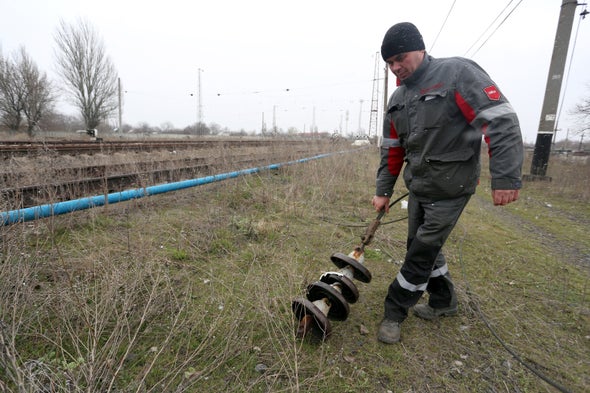 A worker repairs power lines damaged by mutual shelling between Ukrainian forces and Russian-backed rebels near the government-controlled town of Avdiivka in Ukraine's Donetsk region in March.
On the 24th of February, the company operating the electrical grid in Ukraine disconnected the country's power system from the larger Russian-run grid, to which the Ukrainian grid has always been connected. The long-planned separation was supposed to take place. Long in the form of a 72-hour experiment to prove that Ukraine can operate independently, and this experiment was a prerequisite for eventually connecting the Ukrainian network to the European network, a goal that Ukraine has been striving to achieve since 2017, but barely four hours have passed since its launch Experiment until the Russian invasion of the country began.
In the aftermath of the invasion, electrical interconnection of Ukraine with Europe - something that was unlikely to happen before 2023 - became an urgent and urgent goal, and engineers sought to achieve it safely in just a few weeks, and on March 16, they reached the key milestone of synchronizing the two systems, and so on The engineers have done “a year’s work in two weeks”, according to Cadre Simpson, the European Commissioner for Energy. The feat is not unusual in this area, says Paul Dean, an energy policy researcher at University College Cork in Ireland. It is unprecedented that [electrical grid operators] move so fast and so lightly, no power system has ever synchronized so quickly.”
Ukraine began its quest to connect its electrical grid to the European grid in 2005, and began working toward that goal in earnest in 2017, as did the Republic of Moldova, as part of an ongoing effort to align itself with Europe and reduce dependence on Russia, which threatened Ukrainian sovereignty, says Surya Jayanti, an Eastern European policy expert and former US diplomat who served as head of the Energy Department at the US Embassy in Kyiv from 2018-2020: “All that Ukraine wanted was to break away from Russian domination by all means. In the sense, and the electrical network is part of this goal.” The Ukrenergo company, which operates the Ukrainian electricity network, intended, after the trial period ended in late February, to temporarily rejoin the system that supplies Russia and Belarus with energy, but the Russian invasion Making this unacceptable, says Jayanti, “The consequence of this was that Ukraine became isolated, which is very dangerous in terms of energy supply, as it means that there is nowhere to be Ukraine is importing electricity from him, she is simply an orphan.” That was a precarious situation, especially in light of Russian attacks on key energy infrastructure such as the Zaporizhia nuclear power plant. (Jayanti says that the Ukrainian grid was eventually able to operate on its own for the duration of its operation because energy demand fell by about a third as Ukrainians fled the country.)
Three days after the Russian invasion, Uknergo sent a letter to the European Network of Transmission System Operators (ENTSO-E) requesting permission to join the European network early, and Moldelectrica, which operates the electric grid in the Republic of Moldova, applied for Likewise, the next day, while European operators wanted to support Ukraine, they also had to protect their own networks, so the emergency interconnection had to be done with great care, says Laura Mehigan, an energy researcher at University College Cork: “Operators of power facilities and systems are notorious for being careful to avoid hazards because they are responsible for keeping the lights on and keeping everyone safe.”
The electrical grid consists of power generation sources and transmission infrastructure to produce and transmit electricity from places like power plants, wind farms, and solar arrays to homes, hospitals and public transportation systems, Dean says. “Obviously getting power in the right place and time is a complex process, and there is little margin for error.
Networking plays a critical role in this task, as connected systems can share electricity across large areas, so that if there is a surplus of energy produced in one place, demand is met with it elsewhere, says James Glenn, a senior researcher at the Center for Global Energy Policy. Columbia University: “More interconnection facilitates faster, more efficient and more cost-effective energy transmission, and enables us to take advantage of low- or zero-carbon energy sources.” The easy.
Among the core challenges in the interconnection issue is grid synchronization, a task accomplished by Oknergo, Generator Electrica and the European Network of Transmission System Operators last week. power in linkage systems; Frequencies are the heartbeat of the electric grid, and across Europe, power-generating turbines spin 50 times per second in near-perfect harmony, and for Ukraine and Moldova to join that grid, both countries' systems had to be tuned to their own rhythm. This system, says Dean: “We can’t disable the electric grid for an hour, for example, and then try the synchronization process, but the process has to be done while the system is running.” This is like jumping on a moving train or a roller coaster in an amusement park; The train or wagon does not stop, so you have to time the jump very precisely.
But the risks remain even after Ukraine has joined the network; Networking not only means sharing benefits, but also creates the potential for common problems. A problem in one part of the network, such as a station failing to work, can cause a frequency shift that extends across the entire network, and in the worst case scenario, when there is a generator that is not With enough capabilities to ensure power stability, this generator can amplify the frequency change and send it back to the entire grid. “When you're done connecting the two systems, you face the challenge of: Ensure that the larger global interconnection system is as stable and reliable as it was before.” If the network becomes out of sync, this can damage electrically connected devices, such as laptops and microwave ovens, and even power stations.
A safeguard against grid instability inherent in many Ukrainian power plants is inertia; Once heavy turbines—such as those in nuclear plants that house a large portion of Ukraine's energy supply—spin at a certain frequency, changing the turbine's rotation requires a fundamental and sustainable change in power. These turbines are not affected by light flashes in the energy generated in order to rotate them, so their frequency remains constant. The indicated rotary inertia property helps power plants to reduce the impact caused by small changes in energy instead of transferring it to the rest of the grid. In the event of a major failure, This gives the response systems a few precious seconds to get up and running.
However, the European Network of Transmission System Operators representing 35 countries had many concerns about joining the Ukrainian electric grid, and these concerns were not only related to the stability of the network, but also to the market, regulatory and supervisory issues, cybersecurity and legal issues, all These factors combined were a major reason behind setting the original project schedule of six years, and some experts even considered that the completion of the project in six years was an optimistic estimate.
Ukraine has planned to remove the remaining concerns of the European network of transmission system operators over the course of this year, Jayanti says: “The only reason this year's exclusion is possible is that a great deal of work has already been done to confirm all technical specifications, it is true that the emergency declaration What Ukraine got this month by doing the synchronization process allows it to buy energy, but it can't after selling that energy, and for Ukraine to sell energy, it has to install what are called fixed synchronous offsets They are devices that enhance energy stability and stability, and it may take several months before Ukraine can obtain these devices; Given supply chain issues as well as geopolitical hurdles, Jayanti says, however, the European Network of Transmission System Operators (ETSOs) has also passed additional safeguards to protect the European electric grid. To be able to connect Ukraine to the network in any way.
Experts say it is crucial to manage expectations even with this emergency synchronization. “This level of connectivity is relatively limited in scope, it is useful, but it will not replace all Ukrainian energy sources in the event of a power plant failure,” Dean says. It is now moving from power stations to the country's broader distribution network, and if that changes, Ukraine could import some electricity from the European grid of transmission system operators.
The process of connecting the entire Ukrainian network to the European network is likely to continue until the war is over and Ukraine is able to rebuild. “This is the first step in a long journey that is really about integrating Ukraine into the broader [European] system with the goal of integrating more from renewable energy sources and resource sharing,” but these plans “will not progress one iota until peace flutters again in the region. The current situation is very dangerous and extremely risky.”
Tags:
Tech